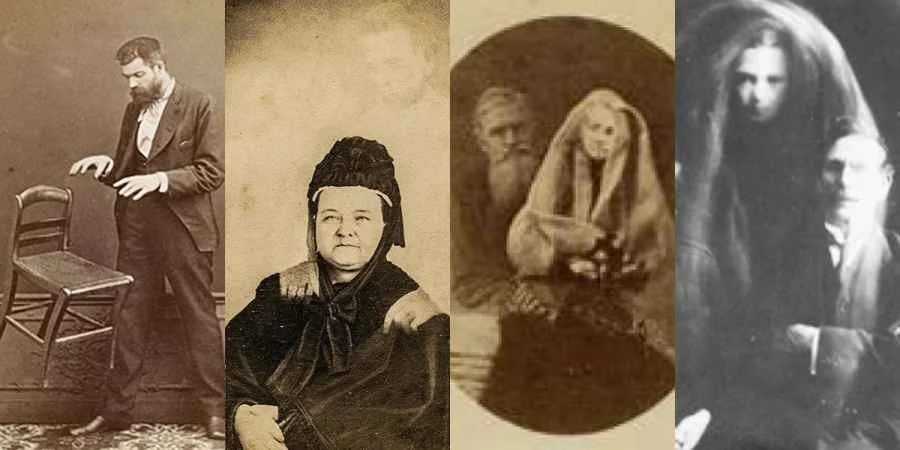
By the time spirit photography reached its peak in the late 19th and early 20th centuries, it had already become a blend of curiosity, grief, technical novelty, and depending on who you ask, a bit of hopeful imagination. The photographs that defined this era became some of the most widely circulated paranormal images of their time. Whether viewed as genuine attempts to show the unseen, or clever examples of what can be achieved in a photographic darkroom, these early photos shaped much of today’s belief in visual evidence.
Let’s look at some of the key figures and images from that early period. We’re not trying to judge whether the photos were real or faked, but instead to understand their influence, why people found them convincing, and how they helped establish the foundations of paranormal imaging as a practice.
William Mumler & The Birth Of Spirit Photography

The first widely recognised spirit photographs were created by William H. Mumler, and whether accidental or intentional, the image set the tone for what would become a booming business. Mumler’s studio capitalised on this growing interest, producing portraits that included faint, misty figures behind or beside the sitter.
How Mumler produced these images has been debated since the 1860s. Many argue that his photos were simply double exposures, a common cause of ghostly figures on film. Others felt Mumler genuinely believed he had a gift, even if the methods weren’t fully understood at the time. Whatever the truth, his work became the template for almost every spirit photographer who followed.
Frederick Hudson & The London Séance Photographs
Across the Atlantic, Frederick Hudson became one of the most prominent early British spirit photographers. Working in the 1870s, Hudson produced images during séances where sitters appeared with translucent faces, drifting figures, or floating „forms” beside them.
The photographs often included props common to séance rooms of the time, like drapes, veils, or muslin fabric. These added atmosphere and, depending on your perspective, either enhanced the spiritual connection or made trickery easier. Despite scepticism, Hudson’s work was influential because he promoted the idea that spirit photography wasn’t just something that happened by chance. It could be summoned under the right conditions, often with the help of mediums.
These images circulated widely in spiritualist circles and helped cement the idea that cameras could capture a momentary thinning of the veil.
Édouard Isidore Buguet & The Paris Phenomenon
Another key figure, Édouard Buguet, worked in Paris during the 1870s and produced hundreds of spirit photographs for clients. His images tended to show more detailed apparitions, sometimes surprisingly well-defined compared to earlier photos.
Even when facing accusations of fraud, Buguet maintained that some of the images he produced were genuinely paranormal. Much like Mumler, his photos fed into people’s desire to believe that these images were real because they offered comfort, evidence, or both.
The Crewe Circle & Materialisation Photography
In the early 20th century, the Crewe Circle, led by medium William Hope, became known for producing spirit photographs that showed fully formed faces, hands, or upper bodies emerging beside sitters. These images often resembled portraits of deceased relatives, sometimes so closely that families recognised them instantly.
Hope’s supporters believed that spirit communication had progressed beyond blurry silhouettes. Critics argued that the recognisable faces suggested the use of previously obtained photographs or plates. This debate didn’t stop the public from treating many of these photos as compelling.
What made the Crewe Circle influential was less about specific techniques and more about giving people images that felt personal. Where early spirit photographs were vague and dreamlike, these were intimate, something that mattered deeply to those who received them.
Why These Early Images Mattered
Even today, many of these photographs are still circulated online, usually detached from their original context. Regardless of whether the techniques were spiritual or mechanical, the photos resonated with the people who viewed them at the time.
These photographs created a framework. If a camera could be used to see spirits in the 1870s, then it made sense for investigators to keep trying with improved technology later. These early photographs set the stage for everything that followed.
About the Author
Steve Higgins
Higgypop Founder & Paranormal Writer
Steve Higgins has been writing about the paranormal for almost two decades, covering ghosts, hauntings, and the paranormal attracting over 500,000 monthly readers.
Further Reading
Dive into the world of the paranormal and unexplained with books by Higgypop creator and writer Steve Higgins.
Alone At The Inn
The full account of a solo paranormal investigation at the Ancient Ram Inn, tied to a documentary film.
Buy Now
The Killamarsh Poltergeist
The story of a family in Killamarsh experiencing strange and unexplained events in their home.
Buy Now
See More on Amazon
-
Richard Felix
Most Haunted1949