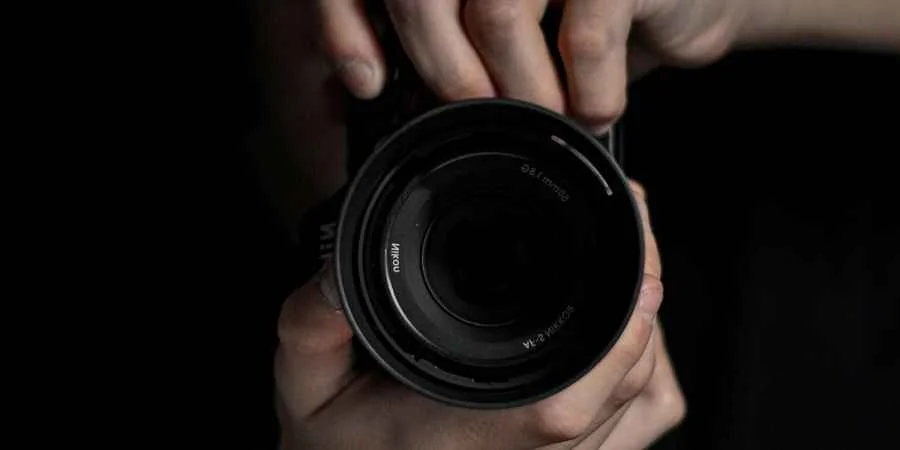
Understanding how your camera sees the world is one of the most useful skills you can develop as a paranormal investigator. The lens, the sensor, and the basic exposure settings all influence what ends up in your photo. They determine how much detail you capture, how much light you record, and how vulnerable your images are to false positives.
Lenses & How They Affect Your Images
The lens is the camera’s eye. It decides how wide your shot is, how much of the scene is in focus, and how much light reaches the sensor.
A wide-angle lens is useful in cramped rooms or corridors because it lets you capture more of the environment. However, it can introduce distortion, bending straight edges or stretching objects at the sides of the frame. In low light, this distortion can exaggerate vague shapes and makes it easier for your brain to latch onto patterns that aren’t really there.
Telephoto lenses, on the other hand, bring distant objects closer but narrow the field of view. They are less commonly used on investigations simply because most haunted locations involve tight, indoor spaces. They also magnify camera shake, so without a tripod you’re likely to end up with streaks or blurring.
Prime lenses, those with a fixed focal length, tend to let in more light and often give cleaner images in dark conditions. The trade-off is that you can’t zoom. For paranormal photography, this sometimes works in your favour because it encourages you to keep your shots steady and predictable rather than relying on digital zoom, which degrades image quality and can emphasise noise and grain.
Whichever lens you’re using, look after it. Dust, fingerprints or a tiny smear on the glass can introduce bright spots, flare, cloudy patches or artefacts that easily pass for something unexplained. A quick wipe before you start goes a long way.
Camera Sensors & What They Can (& Can’t) See
The camera’s sensor converts light into the digital image you see on the screen. Most modern sensors can detect more wavelengths than the human eye, including some near-infrared and ultraviolet light. Manufacturers fit filters over the sensor to block this invisible light so that your everyday photos look normal.
Sensor size affects low-light performance. Larger sensors, like those found in DSLRs and mirrorless cameras, collect more light, reducing grain and improving image clarity. Smaller sensors, such as those in compact cameras and smartphones, struggle more in the dark. This can lead to noisy, speckled images where random clusters of pixels mimic movement, faces or shapes.
Digital cameras generally use one of two types of sensor: CCD or CMOS. Both do the same basic job – converting light into an image – but they read that light in slightly different ways. Most modern cameras use CMOS, while some older or specialist models use CCD. You don’t need to memorise the technical differences, but it’s worth knowing which type your camera has because they handle motion differently. A quick online search or flick through the instruction manual will tell you.
CCD sensors can produce broken or distorted objects when photographing something spinning quickly, such as a fan or propeller. This can look oddly ‘glitched’ if you’re not expecting it. CMOS sensors can suffer from rolling-shutter effects, where fast motion bends or stretches objects. Both are normal camera behaviour and can easily be mistaken for something paranormal.
Key Camera Settings For Paranormal Photography
There are three core settings that shape every photograph you take: shutter speed, ISO, and aperture. Together they control exposure – how bright or dark your photo is – and how your camera interprets movement and light.
Shutter speed controls how long the sensor is exposed. In low-light situations your camera automatically slows the shutter to collect more light. This is why handheld night shots often blur. A slow shutter captures any movement, including the simple motion of your own hands, giving streaks, soft edges, or transparent-looking figures. Many early spirit photos relied on this effect, intentionally or otherwise. Using a tripod helps reduce this.
ISO controls how sensitive the sensor is to light. Higher ISO settings brighten your image but also increase noise. This can introduce grain, speckles or mist-like patches in dark areas of the photo. Many „ghostly” shapes turn out to be high-ISO noise rather than anything in the room at the time.
Aperture controls how wide the lens opens. A wider aperture lets in more light but gives a shallower depth of field. This means only a thin slice of the scene is in focus. Dust close to the lens becomes blurred, glowing and out of scale – often appearing as translucent orbs, especially when illuminated by a flash or infrared light.
Most cameras will try to balance these settings automatically, but auto modes can behave unpredictably in dark environments. A sudden change in lighting – a flashlight beam, passing car headlights, even someone checking their phone – can make the camera rapidly adjust exposure. This can create flickers, bright flares, or strange reflections that only appear for a frame or two.
Flash, Focus & Other Practical Considerations
Whether to use flash on an investigation is always a balancing act. Flash can wash out shadows and reduce the likelihood of capturing misleading light anomalies, but it can also create harsh reflections off shiny surfaces, mirrors, or even dust in the air. Try photographing each location with and without flash so that you can compare.
Autofocus systems can struggle in low light, hunting back and forth for something to lock onto. This can cause blurred shots or short bursts of accidental long-exposure effects. If your camera allows it, switching to manual focus or using a flashlight to help set focus before switching it off again can make a big difference.
Finally, keep an eye on camera apps or special modes. HDR and panorama modes take multiple images in sequence, which increases your chances of capturing semi-transparent or stretched objects simply because the subject moved between exposures. These settings are worth avoiding on investigations.

About the Author
Steve Higgins
Higgypop Founder & Paranormal Writer
Steve Higgins has been writing about the paranormal for almost two decades, covering ghosts, hauntings, and the paranormal attracting over 500,000 monthly readers.
Further Reading
Dive into the world of the paranormal and unexplained with books by Higgypop creator and writer Steve Higgins.
Demystifying The Oracle
A balanced look at Ouija boards, exploring whether they are toys, tools, or dangerous occult devices.
Buy Now
Whispers From The Other Side
A guide to capturing and analysing EVPs for ghost hunters of all levels, covering techniques and theories.
Buy Now
See More on Amazon