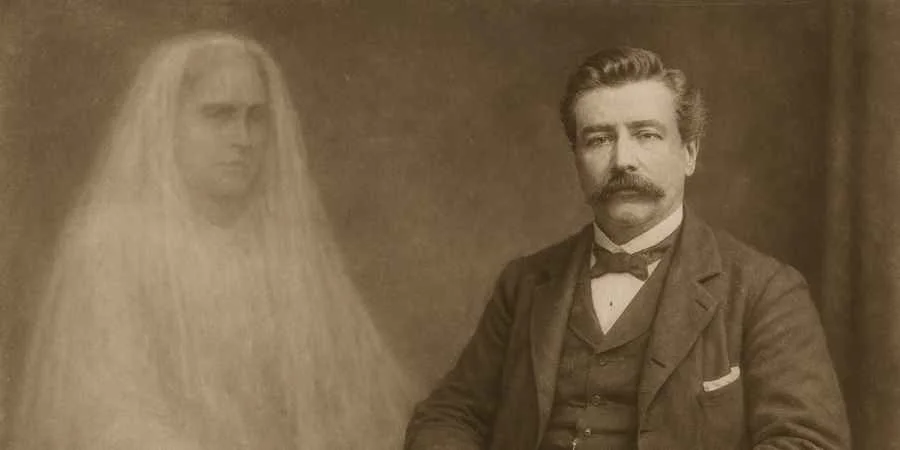
By the time spirit photography reached its peak in the late 19th and early 20th centuries, it had already become a blend of curiosity, grief, technical novelty, and depending on who you ask, a bit of hopeful imagination. The photographs that defined this era became some of the most widely circulated paranormal images of their time. Whether viewed as genuine attempts to show the unseen, or clever examples of what can be achieved in a photographic darkroom, these early photos shaped much of today’s belief in visual evidence.
Let’s look at some of the key figures and images from that early period. We’re not trying to judge whether the photos were real or faked, but instead to understand their influence, why people found them convincing, and how they helped establish the foundations of paranormal imaging as a practice.
Early Beginnings In The 1860s
The roots of spirit photography can be traced back to the early days of commercial photography, when long exposures, glass plates, and chemical processing left plenty of room for errors and unusual artefacts. Into this environment stepped William Mumler, a Boston engraver who accidentally produced what appeared to be a ghostly figure behind him in a self-portrait. Whether it was a genuine mistake or a clever trick is still debated, but the image sparked public fascination.
Mumler went on to build a career photographing grieving families who hoped to see deceased loved ones in their portraits. The timing played a big part in his success. The aftermath of the American Civil War left many thousands of people mourning sudden losses and looking for comfort. Spiritualism was growing rapidly, séances were fashionable, and photography was still mysterious to most. Combining the two created a compelling blend of science and belief.
Techniques, Tricks & Limitations
Victorian photography relied on long exposure times, fragile plates and careful developing processes. These limitations made accidental double exposures, chemical marks and blurred figures surprisingly common. At the same time, many early spirit photographs were later shown to be deliberate fabrications, created using simple darkroom techniques.
Despite this, not every ghostly photograph from the era can be dismissed as a hoax. Many images were taken by honest photographers working with unpredictable materials. When a plate was reused, a subject moved, or a light leak struck at the wrong moment, the resulting image could easily resemble something supernatural.
Spirit Photography & Spiritualism
The rise of spirit photography ran parallel to the popularity of the Spiritualist movement. Séances, table tipping and mediumship blended easily with the idea that spirits could imprint themselves on photographic plates during moments of heightened energy or psychic openness. Some early practitioners believed that either the camera or the photographer possessed a particular sensitivity that made spirit images more likely.
Séance rooms often became makeshift studios where plates were prepared, exposed and developed in front of witnesses. Even so, the lack of standardised photographic practice meant fraud always remained a possibility.
Into The 20th Century
As photography advanced, so did the ways people tried to capture spirits. New films, flash technology and compact cameras reduced the number of accidental artefacts, but also introduced new quirks of their own, from motion blur and light trails to reflections and processing errors.
During the early 1900s, several high-profile medium-photographers claimed to capture ectoplasm, mysterious forms, or semi-materialised figures. These photos now appear theatrical or staged, but at the time they shaped public expectations about what a spirit should look like on camera.
From Film To Digital
As technology improved, spirit photography evolved rather than vanished. Digital cameras introduced instant review, which changed investigations dramatically. Instead of waiting to develop prints, investigators could check an anomaly on the spot and attempt to recreate or explain it. This immediate feedback loop made accidental anomalies easier to rule out.
At the same time, digital sensors brought entirely new artefacts into the mix, such as high ISO noise, compression effects, rolling shutter distortions, and of course the rise of dust-based orbs. As the context document notes, many modern spirit photos happen by chance rather than by design, usually in uncontrolled environments where environmental factors are unknown.
New Technologies
Thermal imaging, night vision, full-spectrum photography and structured light sensors all arrived through non-paranormal fields but were quickly adopted for investigations. Although these devices aren’t historically part of spirit photography, they are now used with the same investigative goal in mind.

About the Author
Steve Higgins
Higgypop Founder & Paranormal Writer
Steve Higgins has been writing about the paranormal for almost two decades, covering ghosts, hauntings, and the paranormal attracting over 500,000 monthly readers.
Further Reading
Dive into the world of the paranormal and unexplained with books by Higgypop creator and writer Steve Higgins.
Hidden, Forbidden & Off-Limits
A journey through Britain’s underground spaces, from nuclear bunkers to secret wartime sites.
Buy Now
Alone At The Inn
The full account of a solo paranormal investigation at the Ancient Ram Inn, tied to a documentary film.
Buy Now
See More on Amazon